Comparison between Mockoon and Beeceptor's API mocking services
Discover the differences between Beeceptor and Mockoon API mocking services: cloud offer, features, and more
What is Beeceptor?
Beeceptor is an online service enabling developers to mock APIs. It offers an easy-to-use and quick way to intercept requests and create mock API servers. The mock API endpoints are deployed to a cloud service and allow for complex configuration thanks to a rules system and a templating language identical to the one Mockoon uses.
Beeceptor is a paid service, but it offers a free tier with up to 50 requests per endpoint per day. The endpoints are public and accessible via a beeceptor.com subdomain.
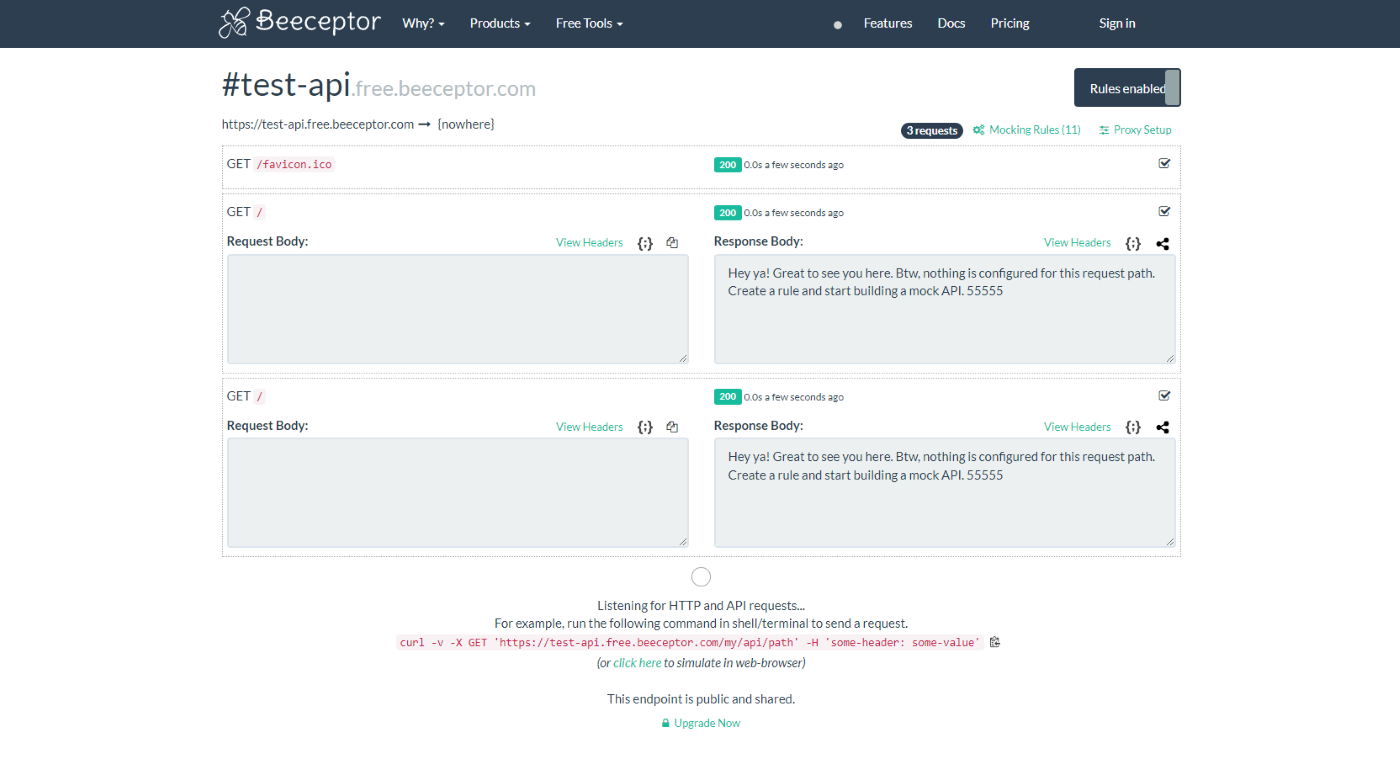 Screenshot of Beeceptor's interface
What is Mockoon?
Mockoon is a set of open-source tools that allow developers to mock APIs quickly and easily. It offers an offline-first and privacy friendly desktop application to design and run mock APIs locally. A CLI and various libraries are also available to deploy your mock APIs anywhere: CI/CD pipelines, servers, etc.
Mockoon features include a powerful templating system to generate dynamic and realistic mock data, a rules system, a proxy mode to partially mock API endpoints, and many customization options: status codes, dynamic headers, TLS, file serving, etc.
Mockoon Cloud is also available for teams and organizations looking for a cloud-based solution. It enables teams to collaborate on API mocking projects and share mock APIs with others by deploying them to the cloud.
💡 Get started with Mockoon: Download Mockoon or Discover Mockoon Cloud
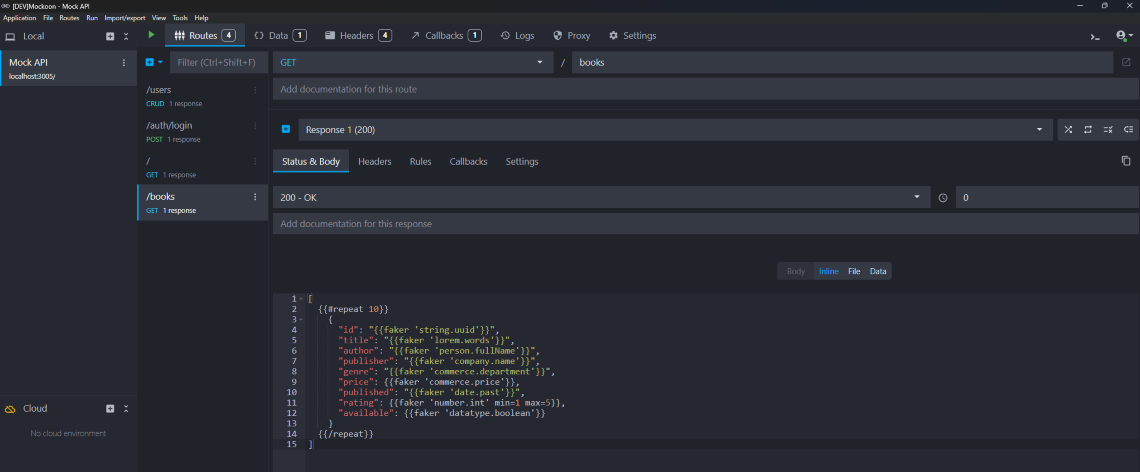 Screenshot of Mockoon's interface
Offer comparison
Below is a comparison of the main characteristics of Beeceptor and Mockoon respective offers:
| Beeceptor | Mockoon | |
|---|---|---|
| Offline/Cloud based | Cloud only | Offline and Cloud |
| Tools provided | Online interface | Desktop application to design your mock CLI, Docker image and GitHub Action to deploy anywhere Web application for our Cloud customers |
| Free/paid | Freemium with free tier | Free for the open-source tools, paid for the Cloud |
| Billing | Billed on a per request basis | Billed per seat |
| Main cloud features | Deployment and team collaboration | Deployments, team collaboration and AI assistant |
| Open-source | ||
| Enterprise support |
Features comparison
While Beeceptor and Mockoon offer similar API mocking capabilities, they have different approaches. Below is a comparison of the main features of Beeceptor and Mockoon:
| API mocking Features | Beeceptor | Mockoon |
|---|---|---|
| Self-host | A CLI is available but only for tunneling to local services | A CLI, Docker image and GitHub Action are available to deploy in headless environments |
| Proxy mode | Can intercept and forward the traffic | Documentation |
| OpenAPI support | Supports OpenAPI specification import | Documentation |
| Recording | Mocks can be created from previously called endpoints | Mockoon can create mock endpoints based on entering requests |
| CRUD operations | Automated CRUD endpoints with fake databases | |
| Response rules | Rules can match request's path or body content | Advanced system of rules |
| Dynamic/realistic data | Templating system similar to Mockoon's one | Advanced templating system and AI assistant to generate realistic fake data |
| Callbacks/Webhooks | Callbacks system | |
| File serving | Documentation | |
| Custom headers | At endpoint's level | At endpoint's and server's levels Supports templating helpers for dynamically generated headers |
| Customizable status code | ||
| Route regex | Documentation | |
| GraphQL support | ||
| Slow network/server simulation | At endpoint's level | At server's and endpoint's levels |
For more comparisons between Mockoon and other tools, check out our other articles:
Mockoon vs Mock Service Worker, Mockoon vs Mockable, Mockoon vs MockServer, Mockoon vs Postman, Mockoon vs ReadyAPI, Mockoon vs Requestly, Mockoon vs Stoplight, Mockoon vs WireMock Cloud